
ACCC association of cancer care centers
Join/Renew
Login
Join/Renew
Login
Education & Resources
ACCC eXchange LogInCorporate Member Sponsored ResourcesPresentations & AbstractsACCC Connect eLearning LogIn
Publications
Oncology IssuesPatient Assistance & Reimbursement GuideTrending Now in Cancer CareBusiness Case Studies for Hiring New Staff
Events
2026 ACCC Leadership SummitAnnual Meeting & Cancer Center Business SummitCapitol Hill DayNational Oncology ConferenceOncology Reimbursement MeetingsOncology State Society Meetings
Policy & Advocacy
2024 Policy Wrap-Up and ACCC 2025 Policy PrioritiesLetters & StatementsAccess, Payment & Reimbursement ReformWhite Bagging & Brown BaggingAdvocacy ResourcesCancer Moonshot
Membership
Join | RenewWho We AreMembership Types & BenefitsCorporate MembersACCC Member Portal FAQMember Directory
Partners
Oncology State SocietiesPartner OrganizationsCME
News
News ReleasesAdvocacy News ReleasesOncology News
About ACCC
Timeline / 50th Anniversary2025 Impact ReportPresident's ThemeACCC Innovator AwardsACCC FellowsBoard of TrusteesACCC Senior Staff
Breast CancerMetastatic Breast Cancer
Gastrointestinal CancerBiliary Tract CancerColorectal CancerGastric CancerLiver Cancer
Genitourinary CancerBladder CancerProstate CancerRenal Cell Carcinoma
Gynecologic CancerOvarian Cancer
Head & Neck Cancer
Hematologic MalignanciesAcute Lymphocytic Leukemia (ALL)Acute Myeloid Leukemia (AML)Chronic Lymphocytic Leukemia (CLL)Mantle Cell Lymphoma (MCL)Multiple Myeloma (MM)Myelodysplastic Syndromes (MDS)
Lung CancerNon-Small Cell Lung Cancer (NSCLC)Small Cell Lung Cancer (SCLC)
Sarcoma
Skin CancerMelanomaNon-Melanoma Skin Cancers (NMSC)
Clinical Practice & TreatmentCancer DiagnosticsCare CoordinationEHR Integration for Biomarker TestingQuality Improvement Collaboration: Integration of Precision Medicine in Community OncologyTreatment
Financial NavigationFAN Boot CampFinancial Advocacy Network (FAN) Resource LibraryPatient Assistance & Reimbursement GuidePrior Authorization
Health Equity & Access3, 2, 1, Go! Practical Solutions for Addressing Cancer Care DisparitiesAppalachian Community Cancer AllianceOncology Advanced PractitionersPersonalizing Care for Patients of All BackgroundsSocial Drivers of Health
Patient-Centered CareAddressing Care Disparities for VeteransAdolescent and Young Adult (AYA)Care Action Plans for People with CancerDermatologic ToxicitiesEmpowering CaregiversGeriatric OncologyHealth LiteracyNutritionOncology PharmacyPatient NavigationPsychosocial Care in OncologyShared Decision-MakingSupportive CareSurvivorship Care
Practice Management & OperationsCancer Program FundamentalsLeadership Sustainment and Engagement VideosOncology Practice Transformation and Integration CenterOncology Team Resiliency
ResearchACCC Community Oncology Research Institute (ACORI)
Technology & InnovationTelehealth & Digital Medicine
ACCCBuzz Blog
CANCER BUZZ Podcast
Oncology Issues
Join/Renew
Login
Breast CancerMetastatic Breast Cancer
Gastrointestinal CancerBiliary Tract CancerColorectal CancerGastric CancerLiver Cancer
Genitourinary CancerBladder CancerProstate CancerRenal Cell Carcinoma
Gynecologic CancerOvarian Cancer
Head & Neck Cancer
Hematologic MalignanciesAcute Lymphocytic Leukemia (ALL)Acute Myeloid Leukemia (AML)Chronic Lymphocytic Leukemia (CLL)Mantle Cell Lymphoma (MCL)Multiple Myeloma (MM)Myelodysplastic Syndromes (MDS)
Lung CancerNon-Small Cell Lung Cancer (NSCLC)Small Cell Lung Cancer (SCLC)
Sarcoma
Skin CancerMelanomaNon-Melanoma Skin Cancers (NMSC)
Clinical Practice & TreatmentCancer DiagnosticsCare CoordinationEHR Integration for Biomarker TestingQuality Improvement Collaboration: Integration of Precision Medicine in Community OncologyTreatment
Financial NavigationFAN Boot CampFinancial Advocacy Network (FAN) Resource LibraryPatient Assistance & Reimbursement GuidePrior Authorization
Health Equity & Access3, 2, 1, Go! Practical Solutions for Addressing Cancer Care DisparitiesAppalachian Community Cancer AllianceOncology Advanced PractitionersPersonalizing Care for Patients of All BackgroundsSocial Drivers of Health
Patient-Centered CareAddressing Care Disparities for VeteransAdolescent and Young Adult (AYA)Care Action Plans for People with CancerDermatologic ToxicitiesEmpowering CaregiversGeriatric OncologyHealth LiteracyNutritionOncology PharmacyPatient NavigationPsychosocial Care in OncologyShared Decision-MakingSupportive CareSurvivorship Care
Practice Management & OperationsCancer Program FundamentalsLeadership Sustainment and Engagement VideosOncology Practice Transformation and Integration CenterOncology Team Resiliency
ResearchACCC Community Oncology Research Institute (ACORI)
Technology & InnovationTelehealth & Digital Medicine
ACCCBuzz Blog
CANCER BUZZ Podcast
Oncology Issues
    • Education & Resources
    • Publications
    • Events
    • Policy & Advocacy
    • Membership
    • Partners
    • News
    • About ACCC
ACCC association of cancer care centers
1801 Research Boulevard, Suite 400, Rockville, MD 20850
Tel: 301.984.9496 Fax: 301.770.1949 Email Us
Contact UsVolunteers
Advertise
Career Center
Terms and Conditions
Privacy Policy
ACCC Rebranding
Copyright © 2026 Association of Cancer Care Centers. All Rights Reserved.
Home / Education And Resources / Practice Management Operations / Fundamentals / Oncology Services / Medical Oncology Services
Oncology Services
  • Imaging Services
  • Medical Oncology Services
  • Oncology Nursing
  • Radiation Oncology Services
  • Surgical Services

MEDICAL ONCOLOGY SERVICES

Recommendation:

The program maintains a dedicated site (or sites) for the delivery of outpatient medical oncology care. Policies and procedures are in place for the safe delivery of systemic and supportive drug therapy to include preparation, handling, and administration. Patient clinical and support services are available either on site or by referral. System is in place to ensure patients have access to medical oncologist for emergent/urgent needs 24 hours a day, 7 days a week.


Overview

Commission on Cancer (CoC) Optimal Resources for Cancer Care: 2020 Standards. National Accreditation Program for Breast Centers Standards, Standard 2.13, “Medical Oncology.”

Program includes, but is not limited to:

  1. Qualified and experienced oncology clinical staff, to include board certified physicians, registered nurses, and other licensed professionals experienced in the care of the oncology patient. One medical oncologist should be identified as the program Medical Director.
  2. Program leadership to include Medical Director and Director of Oncology (or similar organizational role).
  3. Designated examination rooms.
  4. Infusion space for the ambulatory patient population.
  5. Pharmacy services specialized in the preparation and management of chemotherapy, biotherapy, and immunotherapeutic agents.
  6. Onsite or access to procedural space for bone marrow biopsies.
  7. Onsite or access to diagnostic imaging facilities (e.g., CT, MRI, ultrasound, X-ray, echocardiography, PET, and endoscopy).
  8. Onsite or access to clinical laboratory services.
  9. Oncology-specific patient support services to include social work, patient navigation, financial counseling/assistance.
  10. Access to nutritional support, physical, occupational, and speech therapy services.
  11. Charting system/EHR exists to ensure communication of critical patient information is available throughout the continuum of care.
  12. Patient education provided by appropriate clinical staff and includes medication information, treatment side effects, and management of urgent/emergent needs.
  13. Access to genetic counseling services when indicated.
  14. Access to palliative care and hospice when indicated.

Resources to Help

  • Advanced Practitioner Society for Hematology and Oncology (APSHO)
  • American Society of Clinical Oncology (ASCO)
  • Oncology Nursing Society (ONS)
  • Board of Pharmacy Specialty-Oncology Pharmacist
  • Association of Oncology Social Work

Standards/Accreditations

The program should have in place a process for monitoring the quality of the medical oncology care delivered. Metrics should be determined by the program leadership in accordance with nationally recognized benchmarks and standards. A process for evaluating patient treatment protocols against nationally recognized guidelines should be ongoing and reported as part of the overarching organizational quality program.

Examples of accrediting bodies/quality programs:

  1. American College of Surgeons Commission on Cancer (CoC)
    Optimal Resources for Cancer Care: 2020 Standards
  2. American Society of Clinical Oncology (ASCO)
    Quality Oncology Practice Initiative (QOPI) Certification
  3. National Committee for Quality Assurance (NCQA)
    Patient-Centered Specialty Practice (PCSP) Recognition
    Note: NCQA retired the Oncology Medical Home Recognition Program effective October 25, 2019, and launched a redesigned PCSP Recognition process. The redesigned program includes ongoing, sustained Recognition status with annual reporting rather than a three-year recognition cycle.

Featured Resources

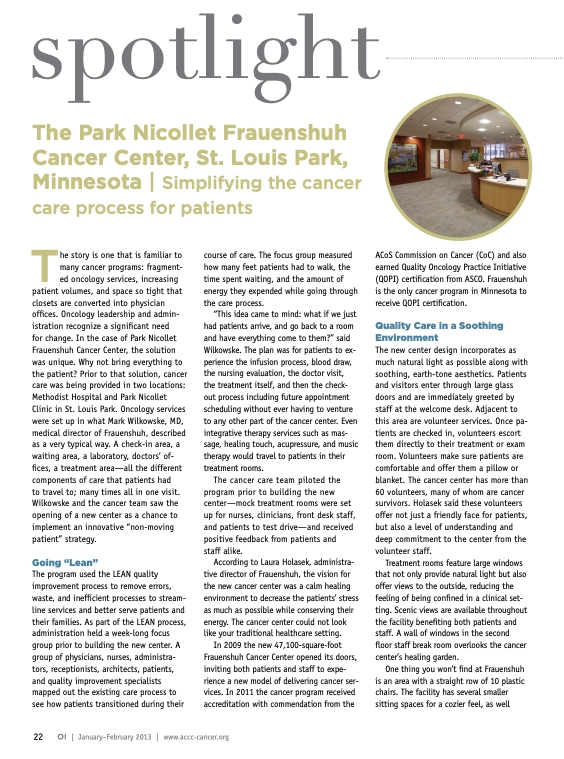
ACCC Member Program: Park Nicollet Frauenshuh Cancer Center, St. Louis Park, Minnesota

When the decision was made to build a new cancer center, the team at Park Nicollet Frauenshuh Cancer Center used the opportunity to assess and improve their delivery of patient-centered care. They used the Lean quality improvement process to remove waste and inefficient processes, to streamline services and to better serve patients and their families. The Lean process included a week-long focus group effort that mapped out current care process and examined how patients moved through care at the cancer center—including measuring the distance patients had to walk to care and how much time they spent waiting. The team went on to create an innovative “non-moving patient” strategy for care delivery that quite literally centers services around the patient.

Staff travels to the patient for all medical oncology care including blood draws, infusion services, and physician visits. Each exam room features a specially designed chair that transitions from recliner to an exam table making the patient experience as seamless and comfortable as possible.
Learn More
ACCC Member Program: Park Nicollet Frauenshuh Cancer Center, St. Louis Park, Minnesota