
Identification of actionable biomarkers continues to drive application of precision medicine in oncology. For patients with lung cancer, molecularly targeted therapies based on expression of specific biomarkers may be potential treatment options. Only through biomarker testing can clinicians discover whether lung cancers have targetable biomarkers.
Despite increasing evidence supporting the role of biomarkers in treatment decision-making for patients with lung cancer, recent studies1-3 report that more than 70 percent of patients treated in the community do not receive biomarker testing as recommended by National Comprehensive Cancer Network (NCCN) clinical practice guidelines, and more than 50 percent of patients do not receive appropriate precision medicine therapies based on the test results.2 Among underserved patient populations, the gap is even wider.4,5 Analysis of CMS claims data has revealed that Medicaid patients are 40 percent less likely to get tested than patients with private health insurance and Medicaid patients are 30 percent less likely to receive targeted therapies after testing, compared to patients with private health insurance.4
The ACCC Eliminating Precision Medicine Disparities project is focused on understanding specific barriers and challenges to equal access to precision medicine among underserved patient communities. Through this project, ACCC seeks to:
The project is guided by an expert multidisciplinary Advisory Committee. ACCC is pleased to partner with LUNGevity for the patient-facing components of this education intervention.
For more information on this project, please contact the ACCC Provider Education department.
Jun 28, 2024
In this episode, CANCER BUZZ TV speaks with Tom Lycan, DO, MHS, assistant professor of Hematology & Oncology at the Wake Forest School of Medicine, about a practical tool that can provide a care plan roadmap for providers and patients to mitigate precision medicine disparities.
Nov 11, 2021
Hear from two authors of an ACCC/LUNGevity Foundation study that identified key areas of clinician need related to biomarker testing in NSCLC.
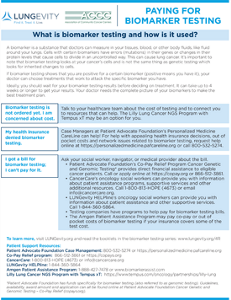
A biomarker is a substance that doctors can measure in your tissues, blood, or other body fluids, like fluid around your lungs. Cells with certain biomarkers have errors (mutations) in their genes or changes in their protein levels that cause cells to divide in an uncontrolled way. This can cause lung cancer. It’s important to note that biomarker testing looks at your cancer’s cells and is not the same thing as genetic testing which looks for inherited changes to cells.
If biomarker testing shows that you are positive for a certain biomarker (positive means you have it), your doctor can choose treatments that work to attack the specific biomarker you have.

While recent advances in precision medicine have substantially changed the management of lung cancer, care must be taken to ensure that these advances do not worsen health disparities. This study included a case component that divided overall respondents into two cohorts to observe how patient characteristics, such as age, socio-economic status, race/ethnicity, and health literacy, affected the likelihood of ordering biomarker testing.

As precision medicine becomes more common in the management of lung cancer, little is understood about the patient experience with biomarker testing, particularly of underserved patients. This study used survey and focus group methodology to determine patient perspectives on the educational needs within this community.
![[Abstract 123] Identifying barriers to equitable biomarker testing in underserved patients with NSCLC: A mixed-methods study to inform quality improvement opportunities](https://cdn.sanity.io/images/gvduir9b/production/27300a4031db3a31d8d7284cf126248de6fc0eb8-320x160.png)
Presented at the 2021 ASCO Quality Care Symposium, September 24 - 25, 2021.
![[Abstract] A United States study focused on patients' understanding of, attitudes towards, and barriers to the use of biomarker testing for NSCLC](https://cdn.sanity.io/images/gvduir9b/production/1902294fdc4edb21efb3f537564280dee8800303-320x160.png)
Presented at the IASLC 2021 World Conference on Lung Cancer, September 8-14, 2021
Now available is a 30-minute eCourse for members of the multidisciplinary cancer care team on how to use consistent, evidence-based health literacy best practices as it relates to lung cancer biomarker testing. Complete “Health Literacy Best Practices for Lung Cancer Biomarkers” to gain a lexicon of health terminology that resonates with patients and their caregivers and access downloadable resources about health literacy and biomarkers.