Tracey F. Weisberg, MD, President and Lead Physician, New England Cancer Specialists
Food insecurity affects 15.8 percent of Maine residents, making it the third-most food insecure state in the nation. When staff at New England Cancer Specialists discovered their patients were among those in need, the practice initiated a partnership with a local food bank where patients can discreetly collect bags of groceries when picking up their medications at the pharmacy. This staff observation led to a new opportunity for an enhanced level of care coordination in their community oncology practice.

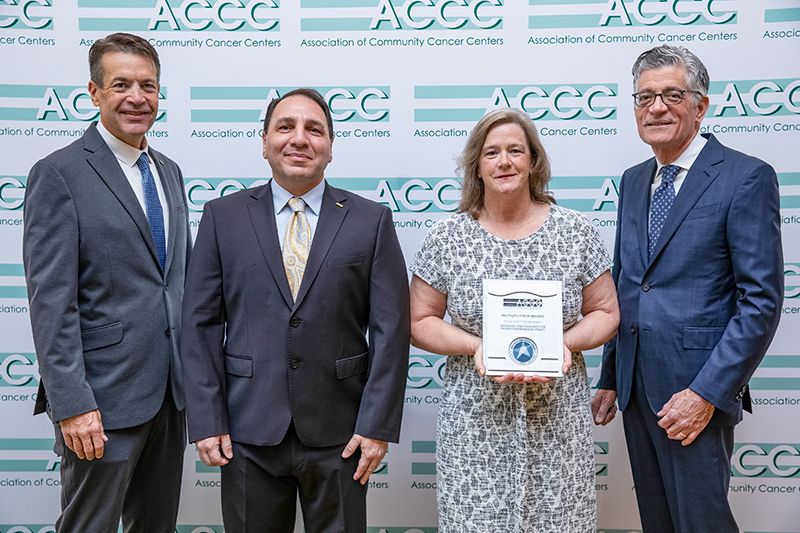
Christian G. Downs, JD, MHA, ACCC Executive Director, Ali McBride, PharmD, MS, BCOP, ACCC President 2019-2020, Tracey F. Weisberg, MD, President and Lead Physician, New England Cancer Specialists, Randall A. Oyer, MD, ACCC President Elect 2019-2020


I think this award elevated the work we had done and made executive leaders across the system aware of our project. Although we had their support, receiving the award helped them understand that we truly did something innovative and with good outcomes.
Sherri Costa, MS, RN, AOCNS® Manager, Cancer Support Services, SEWI & Quality Improvement Coordinator, SEWI Cancer Care, Ascension SE Wisconsin Hospitals


Food insecurity has become an increasing concern for Americans that healthcare providers can often overlook. It is not associated with any one demographic group; anyone can become food insecure at any point in their life. The U.S. Department of Agriculture defines food insecurity as the “limited or uncertain availability of nutritionally adequate and safe foods or limited or uncertain ability to acquire acceptable foods in socially acceptable ways.” In 2017 food insecurity affected 12.7 percent of the U.S. population; 15.8 percent of Maine’s residents experienced food insecurity that same year.
Our data revealed that 61 percent of our male patients and 39 percent of our female patients were food insecure. Our results also revealed that food insecurity impacted the entire age range of the patients we serve, although the highest percentage of food insecure patients are were 50 to 59.