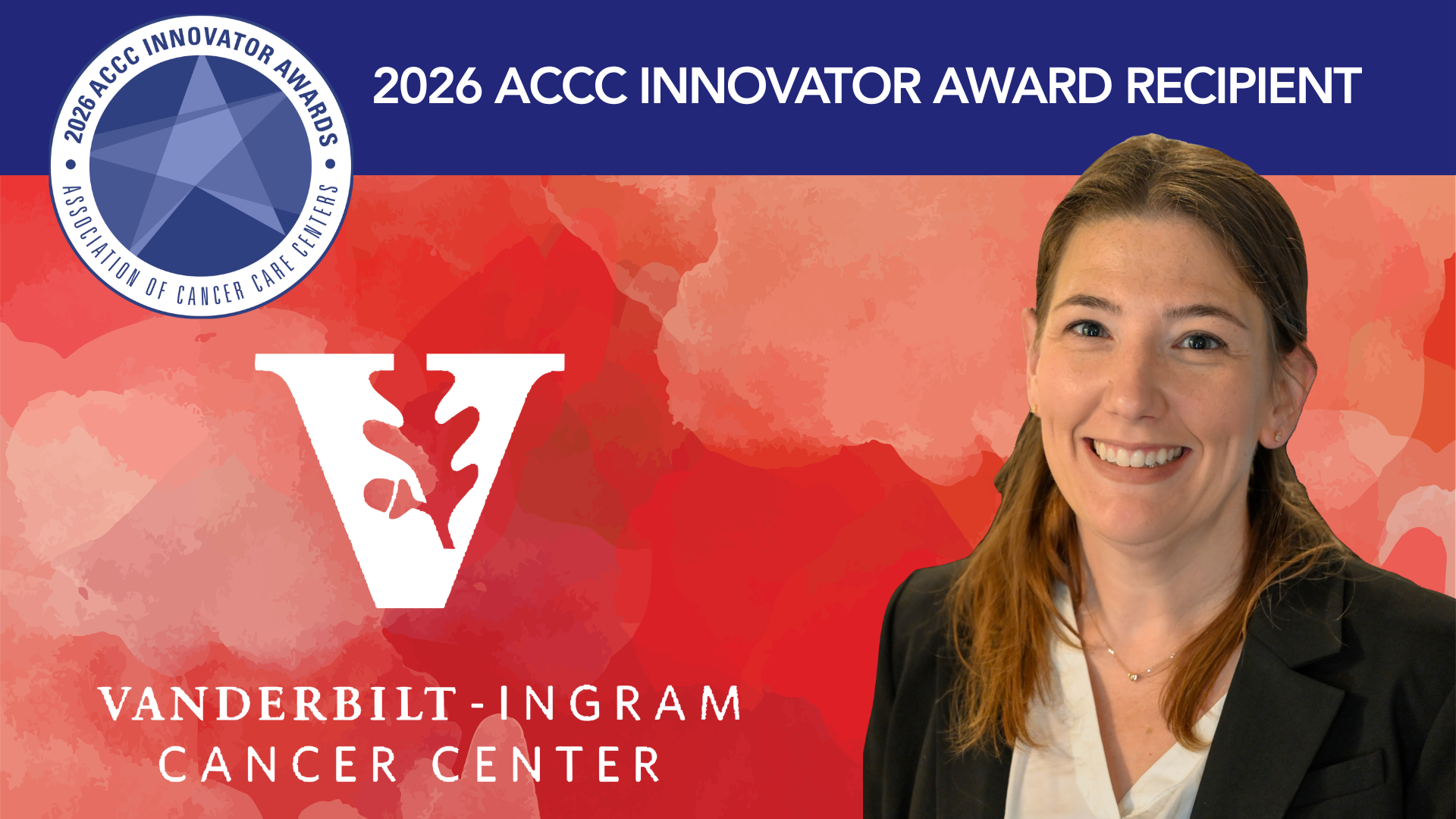
When a patient presents for care in an emergency department (ED), unexpected issues unrelated to their chief complaint may be flagged. To help patients better navigate our complex healthcare system after receiving news of an incidental finding during an ED visit, the Vanderbilt University Medical Center Adult ED and Vanderbilt-Ingram Cancer Center partnered to follow-up with these patients after their discharge to help them initiate the appropriate follow-up care.

This blog post is the third of a seven-part series highlighting the achievements of the 2021 ACCC Innovator Award winners before their in-depth sessions at the ACCC 38th [Virtual] National Oncology Conference. You can learn more about the innovations being recognized this year and the people who pioneered them by joining us live on November 9-10, 2021.
When a patient presents for care in an emergency department (ED), unexpected issues unrelated to the patient’s chief complaint may be flagged. For example, when patients receive MRI imaging or CT scans, ED staff may identify incidental findings (such as adrenal masses or pulmonary nodules) that require follow-up. But leaving it up to patients to navigate their subsequent care appropriately comes with the risk that such follow-up may never occur.
To help patients better navigate our complex healthcare system after receiving news of an incidental finding, the Vanderbilt University Medical Center Adult ED and Vanderbilt-Ingram Cancer Center partnered to follow-up with these patients after their ED discharge to help them initiate the appropriate follow-up care.
“This was a long-standing issue,” says Katharine Klar, RN, BSN, assistant nurse manager at Vanderbilt University Medical Center. “There were various stop-gap measures used, like in-basket messages within the EHR and phone calls, but there was not a codified process. And it was confusing to a lot of our providers and various clinics in the area.”
This issue is not unique to the EDs of any single healthcare system or hospital. “Patients enter our system from over 500 unique locations.” says Nicholas Garland, MS, senior project manager at Vanderbilt University Medical Center. “ The ED is just one of those points. We recognize that this was a problem. We were notifying patients in many cases, but there was no proactive attempt to follow-up with them.”
To prevent patients from “falling through the cracks” and potentially presenting to the cancer center with advanced disease in the future, the medical center's team developed and implemented a pilot program in May 2020. The pilot was designed such that it could leverage existing technology and resources to ensure patients have the option to initiate follow-up care after receiving notification of the presence of an incidental finding in the ED. The new program incorporates a workflow that requires ED providers to complete a follow-up form within Vanderbilt University Medical Center’s electronic health record (EHR) for patients identified to have incidental findings. Completion of this form automatically feeds into work queues within the EHR. Then, assigned nurse navigators or case managers reference these queues to initiate contact with patients directly and facilitate follow-up care.
“This program was very collaborative from the get-go,” says Garland. He and Klar worked with the cancer center and ED leadership to bring together the appropriate stakeholders, including representatives from operations, nursing, case management, and project management areas. As the program expanded, additional nurse navigators, like Klar, were brought on and are dedicated to follow-up on patients with pulmonary-, pancreatic-, or liver-related findings.
“When I call patients, they've either forgotten that they had an incidental finding because they had something more urgent occurring in the ED, or they have no idea what to do about it,” explains Klar. “I think patients feel good knowing that someone is calling them and helping them figure out how to navigate not only their finding, but also the complexities of a health system.”
Other subspecialties and providers at Vanderbilt University Medical Center have shown enthusiasm for the program, hoping to implement it within their disciplines. “We know that this is an issue in the ED, but I don't think it addresses the entire issue, since there are a lot of patients who enter the Vanderbilt University Medical Center system at walk-in facilities or imaging centers, for example," explains Garland. “On the inpatient side, patients who receive cross-sectional imaging, for instance, may also have an incidental finding discovery. There’s still ample opportunity to expand this work and continue to address incidental findings beyond the ED.”
Both Klar and Garland believe that by including key stakeholders and gaining physician buy-in, a similar program can be implemented in other healthcare systems and cancer programs. “I do not think this is something that is unique to Vanderbilt,” Garland says. "I'm hoping others can use our example as a template for doing just that.”
Garland and Klar presented at the ACCC 47th Annual Meeting & Cancer Center Business Summit, sharing a breakdown on how they developed and implemented the program. By attending the ACCC 38th [Virtual] National Oncology Conference, you can learn more about their experiences, including updated data on the program’s continuing impact on its patients and plans to expand its scope.





An at-home option for cervical cancer screening breaks down barriers to care and offers the same level of precision as screening in the clinic.