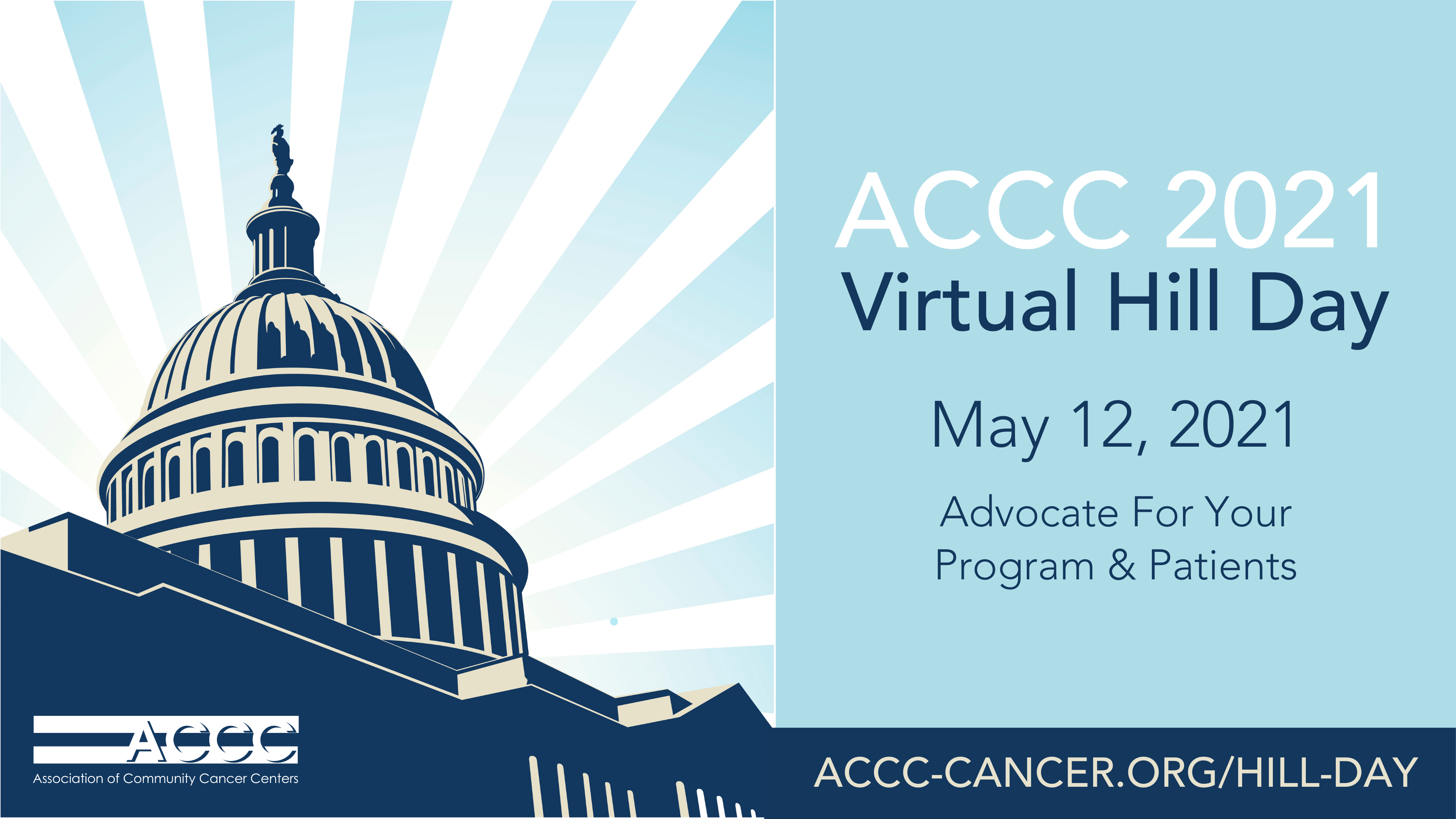
This year's ACCC 2021 Virtual Hill Day, which will take place May 12, will offer ACCC members a new way to experience advocacy trainings, legislative briefings, and Congressional meetings from the comfort of their home or office. This year, ACCC's legislative priorities will focus on the Telehealth Modernization Act and the Safe Step Act of 2021.
By Matt Devino, MPH
Early last year, many patients obtained access to telehealth services for the first time, mostly due to temporary policy changes put in place by the Centers for Medicare & Medicaid Services (CMS). These new policies enabled immunocompromised patients, many with cancer, to reduce the number of times they had to leave their homes in order to obtain treatment and ongoing care, making them less vulnerable to COVID-19.
Before the pandemic, telehealth services were largely nonreimbursable, restricted to the use of patients in remote and rural areas who had existing relationships with a medical office. New policies enacted in response to the pandemic have enabled providers to offer telehealth services to patients living outside of designated rural areas and across state lines from their providers. Providers are able to bill for both video visits and audio-only visits, as the telephone is sometimes the only method of providing remote care to rural and underserved communities without access to modern technologies.
Provider and public support for expanding telehealth services during the public health emergency (recently renewed by Health and Human Services Secretary Xavier Becerra on April 21, 2021) and for continuing the reimbursement of some elements of telehealth after the pandemic is strong. Debate has focused on how much to reimburse telehealth services (Should it be reimbursed as much as in-person visits, or less?), timing (How often should telehealth services be reimbursed, and which types of visits qualify for telehealth?), and flexibility (Which regions of the country should qualify for telehealth, which specialties should qualify, and which types of visits should be reimbursable?). Several bills have recently been introduced in Congress to address these issues.
Proposed Legislation Targets Access to Care
The Ensuring Parity in MA and PACE for Audio-Only Telehealth Act (H.R. 2166), is a bipartisan bill that was introduced into the House on March 23, 2021 to “help ensure Medicare Advantage (MA) enrollees who cannot access the video component during telehealth visits are able to access care through audio visits during the COVID-19 pandemic.” Rep. Terri Sewell (D-AL), a co-sponsor of the bill, stated that the legislation “will ensure that patients are not forced to forego critical care during the pandemic, as many of our seniors live in rural areas without access to broadband speeds that support video connections.”
Another bipartisan bill that also addresses concerns about the continuity of telehealth after the pandemic resolves is the Telehealth Modernization Act of 2021 (S.368/H.R. 1332). Both the House and Senate versions of the bill were introduced in late February 2021, and they focus on extending some flexibilities for telehealth that were authorized during the public health emergency.
These flexibilities include “permanently remov[ing] Medicare's geographic and originating site restrictions, which require a patient to live in a rural area and be physically in a doctor's office or clinic to use telehealth services.” The bill also expands the types of practitioners who may furnish telehealth services “to include any healthcare professional that is eligible to bill the program under this title for their professional services.”
Virtual Hill Day
Due to the ongoing COVID-19 restrictions, ACCC is hosting its annual Hill Day in a virtual format this year. On May 12, ACCC’s 2021 Virtual Hill Day will give our members a new way to experience advocacy trainings, legislative briefings, and Congressional meetings from the comfort of their home or office.
By using an easy-to-navigate online platform, participants in Virtual Hill Day will be able to advocate for federal policies that improve access to quality cancer care. And by discussing the challenges that you—and your patients—face, you can help ensure that future legislation reflects the reality of cancer care delivery.
This year, ACCC's legislative priorities will focus on the Telehealth Modernization Act and the Safe Step Act of 2021 (S.464/H.R.2163), a bill that improves step therapy protocols and ensures patients are able to safely and efficiently access the treatments recommended by their providers, among other legislation. ACCC recently signed onto a letter with other healthcare organizations in support of the Safe Step Act of 2021.
Learn more about Virtual Hill day and register here.




From mental health concerns to fertility preservation, adolescents and young adults with cancer require a specialized approach to treatment and survivorship care. In honor of Childhood Cancer Awareness Month, ACCC highlights a pivotal program from the University of North Carolina Lineberger Comprehensive Cancer Center and resources that meet the critical needs of these patients.