ACCC association of cancer care centers
Join/Renew
Login
Join/Renew
Login
Education & Resources
ACCC eXchange LogInCorporate Member Sponsored ResourcesPresentations & AbstractsPresident's ThemeACCC Connect eLearning LogIn
Publications
Oncology IssuesPatient Assistance & Reimbursement GuideTrending Now in Cancer Care
Events
2026 ACCC Leadership SummitAnnual Meeting & Cancer Center Business SummitCapitol Hill DayNational Oncology ConferenceOncology Reimbursement MeetingsOncology State Society Meetings
Policy & Advocacy
2024 Policy Wrap-Up and ACCC 2025 Policy PrioritiesLetters & StatementsAccess, Payment & Reimbursement ReformWhite Bagging & Brown BaggingAdvocacy ResourcesCancer Moonshot
Membership
Join | RenewWho We AreMembership Types & BenefitsCorporate MembersACCC Member Portal FAQMember Directory
Partners
Oncology State SocietiesPartner OrganizationsCME
News
News ReleasesAdvocacy News ReleasesOncology News
About ACCC
Timeline / 50th Anniversary2025 Impact ReportACCC Innovator AwardsACCC FellowsACCC Senior Staff
Breast CancerMetastatic Breast Cancer
Gastrointestinal CancerBiliary Tract CancerColorectal CancerGastric CancerLiver Cancer
Genitourinary CancerBladder CancerProstate CancerRenal Cell Carcinoma
Gynecologic CancerOvarian Cancer
Head & Neck Cancer
Hematologic MalignanciesAcute Lymphocytic Leukemia (ALL)Acute Myeloid Leukemia (AML)Chronic Lymphocytic Leukemia (CLL)Mantle Cell Lymphoma (MCL)Multiple Myeloma (MM)Myelodysplastic Syndromes (MDS)
Lung CancerNon-Small Cell Lung Cancer (NSCLC)Small Cell Lung Cancer (SCLC)
Sarcoma
Skin CancerMelanomaNon-Melanoma Skin Cancers (NMSC)
Clinical Practice & TreatmentCancer DiagnosticsCare CoordinationEHR Integration for Biomarker TestingQuality Improvement Collaboration: Integration of Precision Medicine in Community OncologyTreatment
Financial NavigationFAN Boot CampFinancial Advocacy Network (FAN) Resource LibraryPatient Assistance & Reimbursement GuidePrior Authorization
Health Equity & Access3, 2, 1, Go! Practical Solutions for Addressing Cancer Care DisparitiesAppalachian Community Cancer AllianceOncology Advanced PractitionersPersonalizing Care for Patients of All BackgroundsSocial Drivers of Health
Patient-Centered CareAddressing Care Disparities for VeteransAdolescent and Young Adult (AYA)Care Action Plans for People with CancerDermatologic ToxicitiesEmpowering CaregiversGeriatric OncologyHealth LiteracyNutritionOncology PharmacyPatient NavigationPsychosocial Care in OncologyShared Decision-MakingSupportive CareSurvivorship Care
Practice Management & OperationsCancer Program FundamentalsLeadership Sustainment and Engagement VideosOncology Practice Transformation and Integration CenterOncology Team Resiliency
ResearchACCC Community Oncology Research Institute (ACORI)
Technology & InnovationTelehealth & Digital Medicine
ACCCBuzz Blog
CANCER BUZZ Podcast
Oncology Issues
Join/Renew
Login
Breast CancerMetastatic Breast Cancer
Gastrointestinal CancerBiliary Tract CancerColorectal CancerGastric CancerLiver Cancer
Genitourinary CancerBladder CancerProstate CancerRenal Cell Carcinoma
Gynecologic CancerOvarian Cancer
Head & Neck Cancer
Hematologic MalignanciesAcute Lymphocytic Leukemia (ALL)Acute Myeloid Leukemia (AML)Chronic Lymphocytic Leukemia (CLL)Mantle Cell Lymphoma (MCL)Multiple Myeloma (MM)Myelodysplastic Syndromes (MDS)
Lung CancerNon-Small Cell Lung Cancer (NSCLC)Small Cell Lung Cancer (SCLC)
Sarcoma
Skin CancerMelanomaNon-Melanoma Skin Cancers (NMSC)
Clinical Practice & TreatmentCancer DiagnosticsCare CoordinationEHR Integration for Biomarker TestingQuality Improvement Collaboration: Integration of Precision Medicine in Community OncologyTreatment
Financial NavigationFAN Boot CampFinancial Advocacy Network (FAN) Resource LibraryPatient Assistance & Reimbursement GuidePrior Authorization
Health Equity & Access3, 2, 1, Go! Practical Solutions for Addressing Cancer Care DisparitiesAppalachian Community Cancer AllianceOncology Advanced PractitionersPersonalizing Care for Patients of All BackgroundsSocial Drivers of Health
Patient-Centered CareAddressing Care Disparities for VeteransAdolescent and Young Adult (AYA)Care Action Plans for People with CancerDermatologic ToxicitiesEmpowering CaregiversGeriatric OncologyHealth LiteracyNutritionOncology PharmacyPatient NavigationPsychosocial Care in OncologyShared Decision-MakingSupportive CareSurvivorship Care
Practice Management & OperationsCancer Program FundamentalsLeadership Sustainment and Engagement VideosOncology Practice Transformation and Integration CenterOncology Team Resiliency
ResearchACCC Community Oncology Research Institute (ACORI)
Technology & InnovationTelehealth & Digital Medicine
ACCCBuzz Blog
CANCER BUZZ Podcast
Oncology Issues
    • Education & Resources
    • Publications
    • Events
    • Policy & Advocacy
    • Membership
    • Partners
    • News
    • About ACCC
ACCC association of cancer care centers
1801 Research Boulevard, Suite 400, Rockville, MD 20850
Tel: 301.984.9496 Fax: 301.770.1949 Email Us
Contact UsVolunteers
Advertise
Career Center
Terms and Conditions
Privacy Policy
ACCC Rebranding
Copyright © 2026 Association of Cancer Care Centers. All Rights Reserved.
Advertisement

Blog

Article

June 9, 2022

Infusion Wallboard Improves the Patient Experience

By Cody Stansel, RN, MSN, NE-BC, OCN, CMSRN; Wendy Howell RN, MSN, OCN; and Heather Jackson, PhD, APRN, NEA-BC, FAANP

Patients receiving anti-cancer infusions often experience lengthy appointment wait times due to the highly complex nature of their care. To address this lack in communication, Vanderbilt-Ingram Cancer Center developed a digital wallboard to better inform patients of their appointment status.

Infusion Wallboard Improves the Patient Experience

Patients receiving anti-cancer infusions often experience lengthy appointment wait times due to the highly complex nature of their care. Wait times can vary depending on a variety of factors like waiting for lab results, contacting providers to clarify orders, and getting orders signed, among others. At large volume cancer centers, this wait is often longer and more frustrating for patients since there is less opportunity for face-to-face communication on any reasons for a delay. The infusion center staff at Vanderbilt-Ingram Cancer Center in Nashville, Tenn., recognized that patient satisfaction scores for the “informed about delays” metric were frequently below target, and patients often expressed their frustration to our front desk staff about the lack of communication.

Inspiration Hits

One day, a registered nurse in the infusion center ordered a pizza from a popular franchise and was inspired by the tool it used to inform customers where their pizza is at throughout the preparation and delivery process. This led our staff member to ask if we could create something similar to keep our patients informed about their appointments. Through investigation, we discovered that surgical waiting areas often have a wall mounted monitor (a wallboard) that is used to inform awaiting families where a patient is located (pre-operation, surgery, post-anesthesia care unit, etc.). The nursing leadership team scheduled a meeting with our information technology (IT) partners to explore what possibilities existed in using similar technology to communicate with our patients in the infusion room.

A multidisciplinary team comprised of informatics nurses, infusion nurses, nursing leadership, and scheduling staff collaborated and proposed creating an electronic wallboard that would inform patients in real time on updates regarding the status of their infusion appointment. Infusion nurses immediately provided information on which delays happen most frequently, and status options were created to communicate this information to patients while following privacy regulations. Upon the wallboard’s implementation, clinical staff were provided education via a tip-sheet and accompanying presentation.

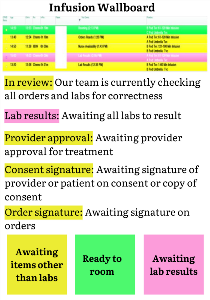
Wallboard_Figure 1

Patient and Provider Impact

Patients are now informed about the infusion wallboard by our front desk staff at their check in, and a poster is available next to the wallboard to educate patients about the various statuses and what they mean.

Over a three-month period, Press Ganey patient satisfaction scores improved from 58.4 percent to 72.5 percent with projected upward trends. Positive patient feedback included comments like:

  • "It's great to have more communication.”
  • “It’s nice to see my name to know [that] they haven’t forgotten about me.”
  • “Now I feel like I can run to the bathroom or cafeteria without fear[ing] they will call me!”

An overwhelming majority of staff (n=7) were supportive of the wallboard (100 percent of respondents, mean=4.6). Clinical staff have since provided great feedback, describing the wallboard as:

  • "A fantastic patient satisfier for our team.”
  • “A great communication tool.”
  • “[The wallboard] helped with questions for the pod leaders and charge nurse … nice help.”
  • “[The wallboard] decreased the number of patients [that are] upset about not knowing where they are at in the process of getting their treatment.”
  • “[The wallboard] helped reduce the number of patients upset about not knowing when they will be treated.”

This wallboard can easily be replicated for use in other infusion centers, particularly those that use Epic as their electronic health record. We are currently exploring how we can utilize this tool in our provider clinics and phlebotomy areas to provide patients a better understanding of current wait times and/or their position in line.

Cody Stansel, RN, MSN, NE-BC, OCN, CMSRN, is the administrative director of Nursing; Wendy Howell, RN, MSN, OCN, is manager, Patient Care Services; and Heather Jackson, PhD, APRN, NEA-BC, FAANP, is administrative director of Advanced Practice at Vanderbilt University Medical Center, Vanderbilt-Ingram Cancer Center in Nashville, Tenn.