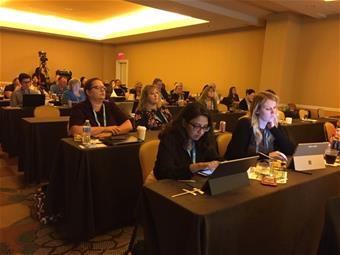
ACCC President Ali McBride, PharmD, MS, BCOP, welcomed attendees to the Oncology Pharmacy Education Network (OPEN) Pre-Conference October 30, in Orlando, Florida. This year marks the 15th anniversary of OPEN, and day's agenda reflected a growing range of responsibilities encompassed under pharmacy management and the evolving role of the oncology pharmacist in an era of accelerating knowledge, information, clinical data, and advances in cancer diagnosis, treatment, and care delivery.
The pre-conference sessions covered pressing issues for oncology pharmacy management experienced across all settings of care from private practice to hospital-based cancer centers to large academic programs. One theme connected day’s discussions: Managing the oncology pharmacy takes a team, and in the value-based environment, everyone on that team needs to be empowered to work at the top of their license.
Here are some highlights from the pre-conference sessions:
Readiness for USP <800>. Spoiler alert: In live polling during this session, nearly half (42%) of attendees reported that their programs have started to prepare but will not be fully USP <800> compliant by 12/1/2019.
Take-home message:Panelists Steven D’Amato, BScPharm, Executive Director, New England Cancer Specialists, and Michael Jensen, RPh, MS, Visante, Inc., stressed that USP <800> is not just about pharmacy; it touches every part of healthcare. In becoming USP compliant, the organizational approach should be what’s best for patients, staff, and everyone involved. Although USP <800> is currently considered “informational,” it will become compendial, presenters said, possibly as early as June 2020.
Supportive Care Clinical Trials. Dan Perksy, MD, Associate Director of Clinical Investigations and Therapeutic Development Program, University of Arizona Cancer Center (UACC), and colleague Ali McBride, PharmD, MS, BCOP, Clinical Coordinator, Hematology/Oncology, UACC, described the Supportive Oncology Research Trials (SORT) program created at their institution with the aim of improving accrual and access to these trials. Participating in the UACC SORT team are physicians, advanced practice providers (NPs, PAs), clinical pharmacists, dietitians, and allied professionals.
Take-home message: To expand your clinical trials program, it takes a dedicated team. Initial steps by the interdisciplinary SORT team at UACC included prioritization of which studies to open first, discussion of the active patient population, consideration of new protocols, and collaboration across departments.
Medically Integrated Dispensing. Panelists Michael Reff, RPh, MBA, Executive Director, National Community Oncology Dispensing Association (NCODA), and Eric Dellara, RPh, Director of Pharmacy, New England Cancer Specialists, shared real-world experiences that have led to advocating for the importance of this care delivery model. Dellara described how at his program pharmacists work alongside nurses and physicians in their medically integrated dispensing model. “We are adjacent to all of the treatment rooms,” he said. This proximity and availability to talk with patients face to face brings patient and operational benefits. In his experience, Dellara said that he has found patients may be nervous about getting their medications. They may need additional education on oral therapies. And there may be questions about costs and copays that patients may be hesitant to ask over the phone. With medically integrated dispensing, patients have consistent communication from all members of their trusted and familiar care team. These multidisciplinary providers know the patient’s history, see the patients in the clinic, and can better ensure that patients know about expected costs, assistance programs if needed, and other avenues to mitigate the financial burden of care.
Take-home message:Medically integrated dispensing provides continuity of care; allows for face-to-face ongoing patient education; may reduce waste; and provides opportunities for skilled, in-person discussion with patients on financial barriers to access and adherence.
Pharmacists’ Role on the Precision Medicine Team. Framing this session, panelists compared key features of the precision medicine programs at their respective institutions and the pharmacist’s role in ongoing discussions around pharmacogenetics, pharmacogenomics, and biomarkers in practice. The conversation, moderated by Howard McLeod, PharmD, Medical Director, DeBartolo Family Personalized Medicine Institute at the Moffitt Cancer Center, left no question about the pivotal importance of pharmacy on precision medicine teams. Joining in discussion with Dr. McLeod were Jennifer Godden, PharmD, BCOP, Co-Director, Oncology Precision Medicine, Advocate Aurora Health Care, and Cory Vela, PharmD, BCOP, Personalized Medicine Cancer Fellow at Moffitt Cancer Center, and most recently Clinical Pharmacy Specialist, Precision Medicine, University of Kentucky Markey Cancer Center.
Take-home message:Pharmacists play a pivotal role as part of the precision medicine team. Of note, in response to a live polling question during this session only 10% of attendees report that their organizations have oncology pharmacists dedicated to precision medicine.
Building an Oral Oncology Program from the Ground Up. Panelist Marie Sirek, PharmD, BCACP, took on the role of clinical pharmacy specialist in oral oncology at Billings Clinic in 2017. The largest healthcare organization in Montana, Billings Clinic cares for many patients living in rural areas with 12 locations serving Wyoming and western North Dakota. Over the past two years, Dr. Sirek has initiated integration of a pharmacist-led oral oncology program at the clinic. Such programs can help with barriers to patient adherence, monitoring of patient labs, education, and more.
Take-home message: Areas of opportunity for pharmacists in practice include, but are not limited to, collaborative practice agreements (subject to state law); medically integrated dispensing; rural oncology care; telemedicine; and therapy management. According to a live poll during this session, only one-third (33%) of attendees report having an oral oncology program at their practice.
As the value-based care delivery landscape is further defined, the management and practice of oncology pharmacy will continue to evolve. In the midst of change, the Oncology Pharmacy Education Network creates space for needed conversations on common concerns, challenges, and potential paths forward for the practice of oncology pharmacy. Today's pre-conference sessions made clear: it takes a team. Stay connected.

In recognition of Leukemia and Lymphoma Awareness Month, ACCC compiled a group of resources to help care teams navigate two of the most commonly diagnosed adult leukemias: acute myeloid leukemia and chronic lymphocytic leukemia.